The word luxury has been applied to so many wedding products — with so little precision — that it has become almost meaningless as a descriptor. A bakery box with a gold sticker calls itself luxury. A three-tier cake with a rhinestone topper calls itself luxury. A prefabricated design with premium pricing calls itself luxury. And couples, navigating a market thick with this language, are left without a reliable framework for what they are actually paying for.
This is an attempt to rebuild that framework — to articulate what genuine luxury in wedding cakes actually looks like, so you know it when you see it and can distinguish it from the imitations.
Beyond Price: The Markers That Actually Distinguish Luxury
Luxury in any product category is not primarily a function of price. It is a function of quality applied consistently across every dimension of the offering: materials, craft, design, and experience. Price may correlate with these qualities — but it does not produce them, and a high price tag attached to mediocre execution is not luxury. It is just expense.
The markers that actually distinguish a luxury wedding cake are visible — if you know where to look — before the first slice is cut.
They are present in the texture of the finish, in the coherence of the design, in the conversation that produced the cake, and in the way the baker talks about their work. None of these require expertise to perceive. They require attention.
Ingredient Quality as the Starting Point
Every luxury conversation about a wedding cake has to begin here, because ingredient quality is the thing that most directly shapes the eating experience — and the thing most often obscured by visual presentation.
The difference between a cake made with European-style cultured butter and one made with standard commodity butter is perceptible in the first bite. Cultured butter carries a deeper, slightly tangy richness that transforms buttercream from sweet to complex. The difference between real vanilla extract derived from quality beans and artificial flavoring is similarly detectable — not as a sharp contrast, but as a quality of depth and finish on the palate that either is or is not present.
Fresh dairy in fillings and custards. Seasonal fruit in compotes. Chocolate with actual cacao content rather than artificial chocolate flavoring. These are not luxury embellishments. They are the foundation. Everything built on them — the design, the finish, the presentation — inherits the quality or the absence of it.
A tasting box is the most direct way to evaluate this. The difference between ingredient tiers is something your palate resolves in one bite, not something you need to research or debate.
The Craft of the Finish
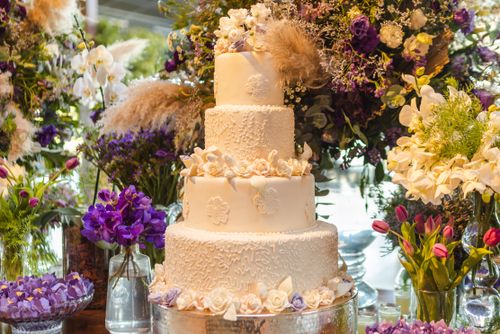
The surface of a wedding cake is the most observed element of the entire piece. Guests approach it before it is cut. It is photographed from multiple angles and distances. It sits in the room for hours before it is served. The finish — whether buttercream, fondant, or textured application — has to hold up to sustained visual scrutiny.
A luxury finish is defined by two qualities: precision and intention. Precision means the edges are clean, the surfaces are even, the texture is consistent. Intention means the finish style was chosen for a reason, and that reason is legible in the finished result.
A rushed finish is always visible. The correction marks. The edges that do not quite meet cleanly. The texture that is uneven in a way that reads as accident rather than design. A luxury baker works at a pace that allows the finish to be right, because they know the surface is the first thing every guest reads.
Design Intentionality Over Design Density
There is a persistent misconception that luxury in cake design means more — more decoration, more elements, more visual complexity. The opposite is closer to the truth.
Genuine design luxury is marked by intentionality: every element present was placed there for a reason, and there is enough negative space for each element to register clearly. A single cascade of pressed botanicals on an otherwise spare surface communicates design thinking. The same surface covered with multiple competing elements — florals, painted patterns, metallic accents, ribbon details — communicates decoration anxiety.
The most sophisticated wedding cakes have something in common: they could not easily be improved by addition. Every element is load-bearing. Nothing is present to fill space. This restraint is genuinely difficult to achieve — it requires design confidence — and when it is achieved, it is immediately legible as a higher order of taste.
Structural Engineering Nobody Sees
The interior architecture of a tiered wedding cake is as important as its surface, and considerably more technical. A four-tier cake that travels 25 miles through California traffic, arrives at a venue, is set up by one person in a limited window, and then holds its structure through a four-hour reception under variable temperature conditions — that is not an accident of good fortune. It is the result of engineering.
Dowel placement, tier plate selection, central support structures, the calculation of weight distribution across tiers, the relationship between internal structure and the surface finish — a luxury baker has thought through all of this with precision. The cake does not shift. The tiers do not lean. The surface does not show stress.
This invisible competence is one of the clearest differentiators in the market. The right questions reveal it: ask how the baker approaches delivery for a venue at your distance. Ask what their failure protocol is if something goes wrong during transport. A confident, specific answer indicates the engineering exists. A vague one indicates it may not.
The Consultation as Evidence of Luxury
How a baker conducts a consultation tells you more about their standard than almost anything else. A luxury consultation is a design conversation — not a product selection. It explores your venue, your aesthetic, the palette of your celebration, the design language of your florals, and what you want the cake to communicate about you. It produces a design that could not have been made for anyone else at any other event.
A baker who asks these questions and listens to the answers with genuine curiosity is practicing a form of luxury that shows up directly in the finished cake.
The consultation is where you and your baker develop a shared language for the cake. That language produces coherence — the quality that makes a finished cake feel inevitable, as though it could have been designed no other way. Coherence is not achievable without genuine conversation.
The Delivery and Setup as the Final Act
Luxury does not end when the cake leaves the studio. The delivery and setup are the final chapter of the work, and they are as important as every chapter before. A cake that arrives at the venue exactly as designed — structurally sound, finish intact, positioned correctly, accompanied by clear handoff communication — is the completion of a promise.
Many bakers treat delivery as a logistics function. Luxury bakers treat it as a service function. The distinction produces a different arrival experience: one where the venue coordinator receives a professional who knows the property, communicates clearly, and handles the setup with the care the cake deserves.
This is the full picture of what a luxury wedding cake is. Not just a beautiful object. A considered, crafted, consistently executed experience — from the first ingredient sourced to the final placement at the reception venue.